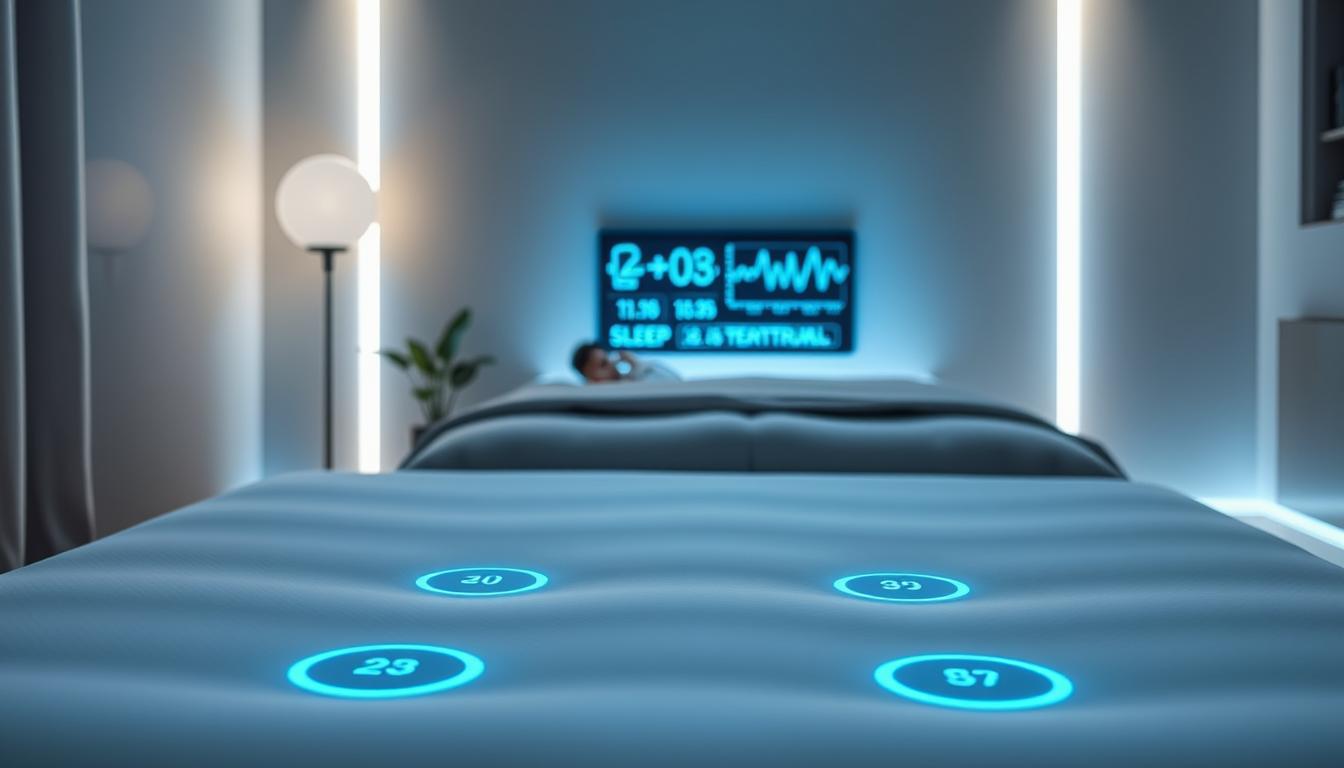
Now you can track your sleep without wearing anything. Smart bed sensors and non-wearable sleep trackers do the job. They sit under your mattress or in your bedside area, collecting data on breathing, heart rate, and movement.
These devices are more comfortable than rings like the Oura Ring or wrist systems like WHOOP. They don’t get in the way of your sleep.
Prices vary a lot. Under-mattress pads and bedside radar units cost between $100 and $330 CAD. For example, the Withings Sleep Analyzer is about $170 CAD, and the EMFIT QS is around $330 CAD. The Google Nest Hub is a bit cheaper at about $130 CAD.
Smart mattresses and full systems are pricier, often costing $3,000–$8,000+ CAD. Brands like Eight Sleep or Sleep Number fall into this category. Some platforms charge for their services, like Eight Sleep’s yearly subscription of about $199 USD.
Adding an under-mattress sensor to a good traditional mattress is a cost-effective option. It’s cheaper than buying a smart mattress over 5–10 years. You get the benefits of bed monitoring technology and sleep tracking without breaking the bank.
These devices have many uses. They’re great for home monitoring, checking for sleep apnea, workplace wellness, assisted living, and sleep research. Remember, sleep data is health data. Think about where your data goes, your deletion rights, and if third parties can access it if a company stops service.
Understanding Smart Bed Sensors
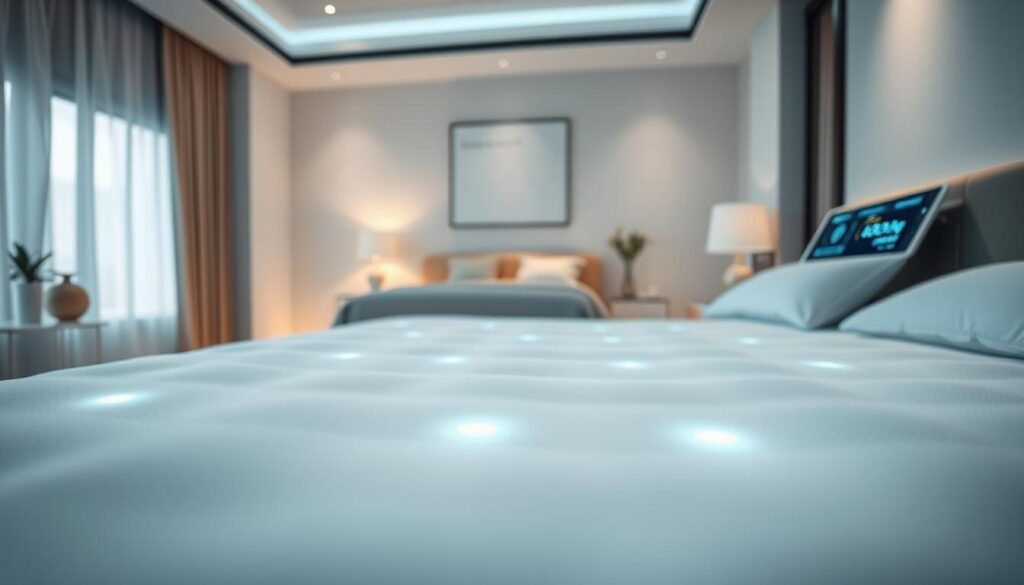
There are three main types of smart bed sensors. They vary based on your needs and budget.
- Under-mattress BCG pads use ballistocardiography to sense micro-vibrations from heartbeat and breathing. Popular options include Withings Sleep, EMFIT QS, and Sleepme under-sheet pads.
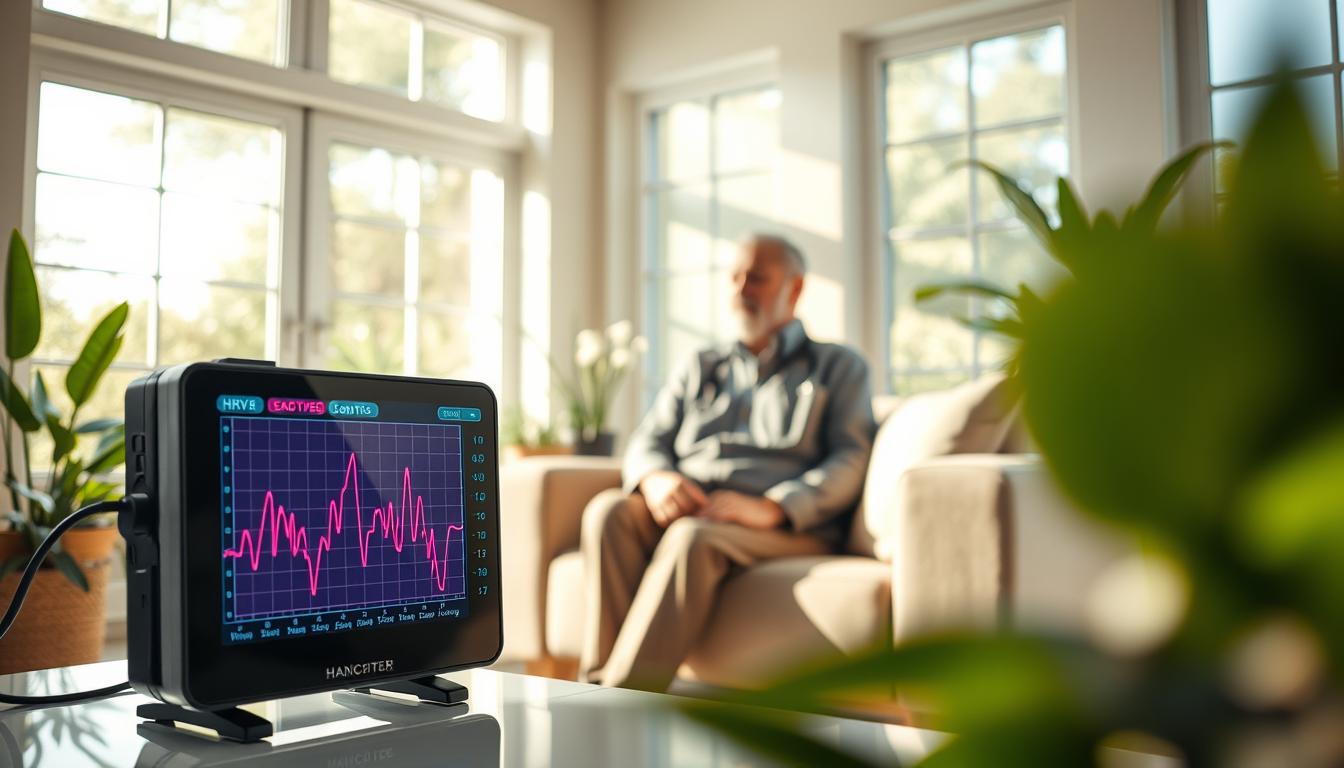
- Bedside radar or sonar units monitor without contact. Devices such as Google Nest Hub use Soli radar to track respiration, movement, and sleep stages.
- Sensor-embedded mattresses and mattress covers have built-in sensing plus active features. Examples include Eight Sleep Pod, Sleep Number 360, and Sleepme Dock Pro.
The technologies behind these sensors are different. Ballistocardiography (BCG) captures tiny body motions through the mattress surface. Radar and sonar detect movement and breathing from a short distance. Integrated smart mattress technology mixes sensors with water, air channels, or heating and cooling elements to control temperature and support.
These sensors can track various metrics. This includes heart rate, heart rate variability (HRV), respiratory rate, sleep duration, movement, stage estimates, snoring, and signs of sleep apnea.
Each type has its own benefits. Under-mattress pads work with almost any bed and can be replaced independently of the mattress. Bedside radar is easy to set up and stays non-contact if you prefer minimal hardware. Fully integrated smart mattress technology adds temperature control and zoned firmness but tends to cost more and may involve subscription services.
Make sure to check compatibility. BCG accuracy depends on the mattress’s construction. Foam, latex, and hybrid mattresses with consistent top layers transmit micro-vibrations best. Very thick pillow-tops and waterbeds can reduce signal clarity for connected sleep devices.
Benefits of Non-Wearable Sleep Technology
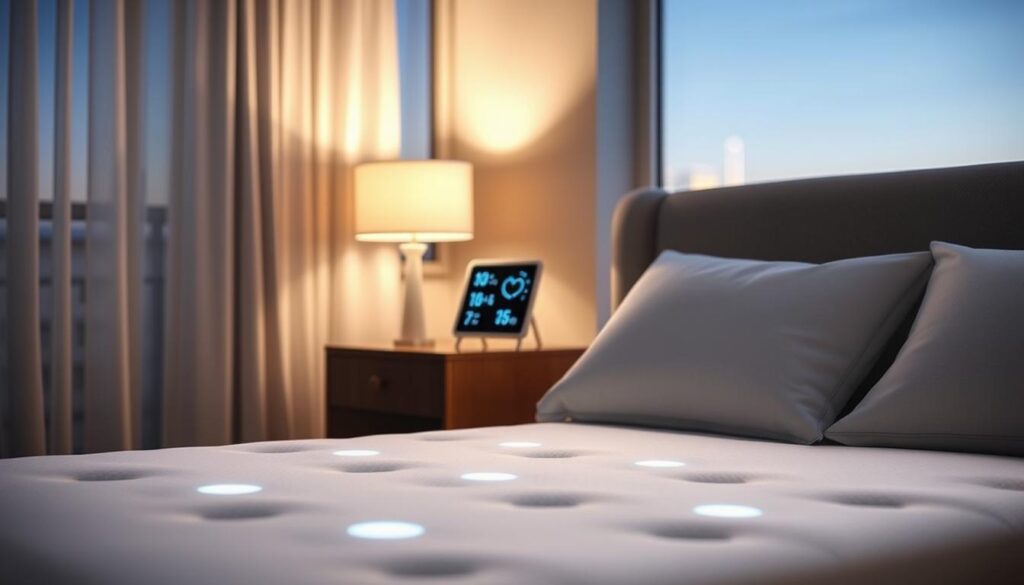
Non-wearable devices offer comfort. They don’t have rings, wristbands, or headgear that press on your skin. This makes them great for those who don’t like wearables and want an easy solution.
These tools let you monitor sleep over time without touching you. Under-mattress sensors and bedside units collect data for many nights. They show trends in sleep, heart rate, and movement. This is key for keeping an eye on health at home.
Well-known products offer real value. The Withings Sleep Analyzer checks for sleep apnea without straps. EMFIT QS tracks heart rate and recovery for athletes. Google Nest Hub monitors breathing and disturbances with just bedside sensors.
These devices are versatile. They work in homes, assisted living, workplaces, and research. Their non-intrusive nature makes them easy to use for many people.
- Comfort and compliance: better user acceptance versus wearables.
- Long-term trend analysis: multi-night data for reliable insights.
- Clinical screening and athlete recovery: actionable health metrics.
They’re also cost-effective. An under-mattress sensor, costing about $100 to $330 CAD, offers many benefits. You can keep your current mattress and just upgrade the sensor.
These systems fit into smart bedroom tech and digital sleep solutions. They work with apps and smart home devices. This gives you personalized tips, alerts, and health data integration.
Choosing the right device depends on your needs. For simple tracking, a budget under-mattress sensor is enough. For detailed clinical or athlete metrics, choose a specific model.
Key Features of Smart Bed Sensors
Most smart bed sensors track important sleep metrics. These include heart rate, heart rate variability, and respiratory rate. They also monitor body movement, sleep stages, snoring, and total sleep time.
Some advanced models offer special features. For example, Withings Sleep Analyzer checks for sleep apnea. EMFIT QS focuses on athlete recovery and heart rate variability. Eight Sleep Pod has dual-zone temperature control that changes with sleep stages.
How these devices connect to your life is key. Look for APIs, HL7 or FHIR for medical use. Smart home links through Wi-Fi let your devices adjust. Telehealth-ready devices let doctors check your sleep trends remotely.
Power and setup vary by device. Under-mattress pads often use USB or a wall adapter. Smart mattresses need a dedicated power unit and pump. Radar bedside units require wall power and stable Wi-Fi for streaming.
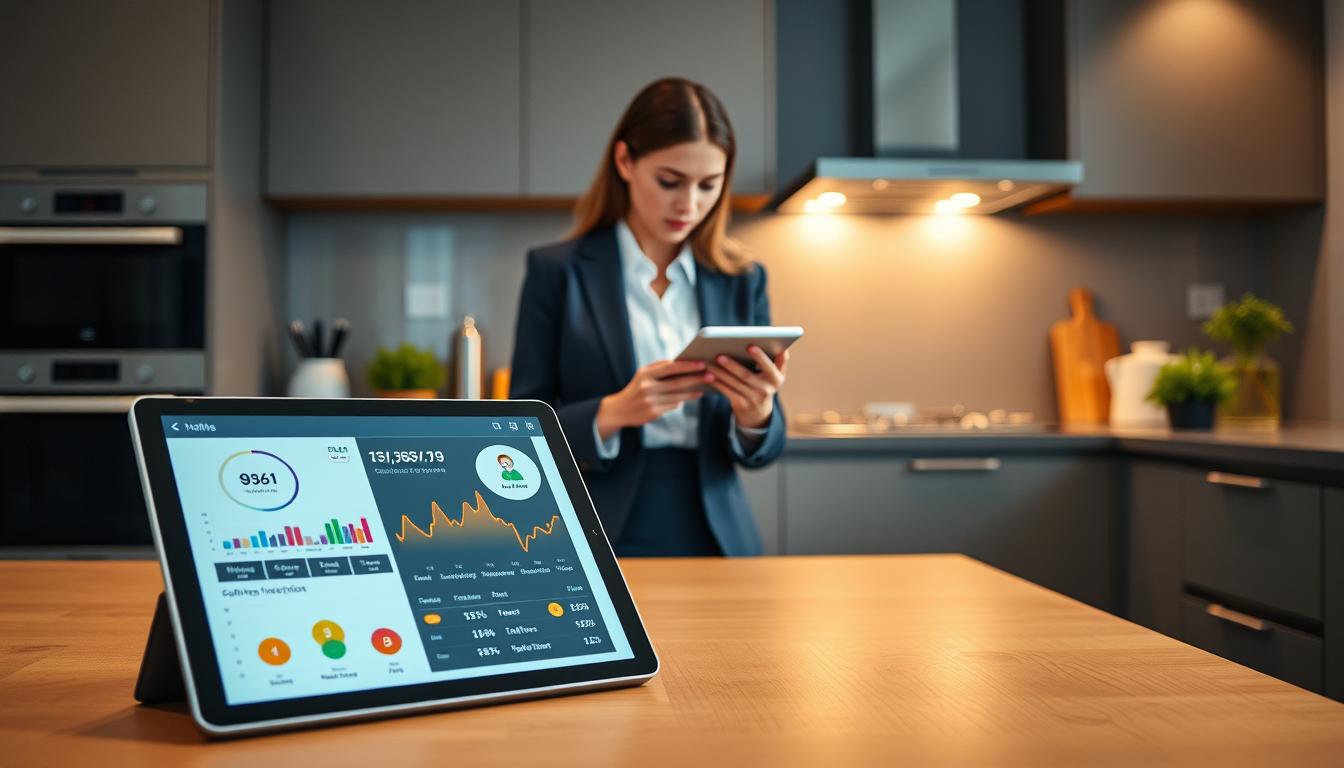
Software is important for daily use. Compare app clarity and the availability of insights or coaching. Check if key features require a subscription. Also, see where your data is stored and if you can delete it if you need to.
- Placement and compatibility: sensor pads sit under the chest area for best BCG signals.
- Mattress limits: thicker or highly sprung innersprings may reduce fidelity.
- Best types: foam, latex, and hybrid mattresses with foam comfort layers give the most reliable readings.
When shopping, consider both hardware and software. The right mix of smart sensors, health tracking, and connected devices will meet your sleep needs and fit your current ecosystem.
How Smart Bed Sensors Measure Your Sleep
Smart bed sensors convert tiny body signals into sleep insights. Under-mattress pads use ballistocardiography (BCG) to catch vibrations from your heartbeat and breathing. These vibrations are then turned into heart rate, heart rate variability (HRV), respiratory rate, and movement.
Bed monitoring technology also includes radar and sonar methods that sit on a nightstand. For example, Google Nest Hub uses Soli radar to track chest motion and body shifts. Radar provides data on breathing and movement but can’t measure HRV or heart rate without skin contact.
Some smart mattresses have sensors and wiring inside the mattress core. These sensors collect the same physiological signals. They can connect to systems like water-based temperature control, like in the Eight Sleep Pod. This setup supports automated sleep monitoring and real-time climate adjustments.
Algorithms process raw signals to estimate sleep stages like light, deep, and REM. The accuracy of these estimates varies among brands and models. Studies comparing these devices to polysomnography show mixed results. Some devices are good at detecting sleep and wake but struggle with stage transitions.
- BCG works best on foam or latex layers that transmit vibrations cleanly.
- Very thick or uneven mattresses can weaken BCG signals.
- Presence of a partner, sensor placement, and body position affect readings.
Different manufacturers have different focuses. EMFIT focuses on HRV and recovery metrics for athletes. Withings markets sleep apnea screening and broad consumer features. Some smart bed sensors require subscriptions to unlock full analytics and long-term reports.
When choosing sleep tracking devices, consider sensor type, mattress compatibility, and the metrics that matter to you. These factors affect how well automated sleep monitoring shows your true sleep patterns.
Popular Smart Bed Sensor Brands
There are many smart bed sensors to choose from. The Withings Sleep Analyzer is an under-mattress pad for about $170 CAD. It tracks sleep stages, heart rate, and snoring, and even screens for sleep apnea. You get basic features for free, thanks to Withings’ long history in health products.
EMFIT QS is great for athletes and those focused on recovery. It’s an under-mattress sensor priced around $330 CAD. It tracks HRV, heart rate, respiratory rate, and movement. It offers detailed recovery metrics without needing a subscription, perfect for those who prefer one-time purchases.
The Google Nest Hub (2nd Gen) is a bedside option for about $130 CAD. It tracks sleep duration, disturbances, breathing patterns, and snoring. Its radar is non-contact and budget-friendly, but it can’t measure HRV or direct heart rate like some other health tracking sensors.
Sleepme offers an under-sheet pad and the Sleepme Dock Pro system. The pad costs about $200 CAD, and the Dock Pro is between $700–$900 CAD. These devices monitor sleep stages, heart rate, and respiratory rate. Some advanced features require a subscription, and you can add water-based heating and cooling for temperature control.
Eight Sleep provides a full smart mattress or active cover system for about $3,500–$5,000+ CAD. It tracks sleep stages, heart rate, and respiratory rate. It also has dual-zone water temperature control and auto-adjustments. Premium features often require a subscription, which can raise long-term costs and maintenance questions.
Sleep Number 360 Smart Bed offers adjustable air firmness and built-in tracking for heart rate and breathing. Prices range from $3,000–$8,000+ CAD. Core tracking features don’t need a subscription, and the bed includes climate and foot-warming options.
- ResMed and Beddit are in both clinical and consumer spaces with legacy devices that overlap with health tracking sensors.
- EarlySense focuses on clinical-grade under-mattress monitoring for hospitals and care settings.
- Fitbit and Google ecosystem offerings expand the range of connected sleep devices you can pair with apps and wearable-free systems.
When comparing brands, consider tracking depth, price, subscription models, and privacy. Pick a product that fits your budget and meets your needs for better sleep insight.
The Science Behind Sleep Patterns
Learning about sleep science makes you understand smart bed sensor data better. Things like temperature changes, heart signals, and movement affect your sleep each night.
Thermoregulation is key in starting and deepening sleep. Okamoto-Mizuno and Krauchi’s studies show cooler temperatures help you sleep better. Brands like Eight Sleep use auto-cooling in their smart mattresses to help with this.
Heart rate and heart rate variability show how balanced your body is. HRV data helps see how well you recover and handle stress. Devices like EMFIT QS track HRV to help athletes recover.
Algorithms use movement, heart rate, HRV, and breathing to guess sleep stages. Non-wearable systems track different sleep phases to show trends. Polysomnography is the top method for precise sleep stage tracking.
Home sleep recordings are valuable for quick checks. Tools like the Withings Sleep Analyzer can spot sleep apnea and other issues. Long-term data often shows real-life patterns that lab tests might miss.
- Behavior links: broken sleep hurts focus and work during the day.
- Population use: employers and researchers use trends to improve wellness.
- Research caveats: it’s important to be open about algorithms and compare to polysomnography for trust.
Using smart bed sensors and mattresses gives you useful long-term trends. Mixing device data with expert advice gives the best look at your sleep health.
Common Concerns About Smart Bed Sensors
When you look for bed monitoring tech, you’ll find trade-offs in accuracy. Non-wearable devices guess sleep stages by tracking breathing and movement. They might not always get it right, unlike polysomnography.
Radar trackers can’t directly measure heart rate variability. The type of mattress you have also affects how well these devices work. For example, waterbeds and thick pillow-tops can weaken the signals.
Your concerns about privacy and data are important. You should know where your sleep data is stored and if you can delete it. Look into policies on sharing data with third parties and what happens if the company goes out of business.
Subscription models can add risks. Some services lock important features behind yearly fees. For instance, Eight Sleep’s top tier costs around $199 USD per year. If you stop paying or the service ends, you might lose access to features you rely on.
Think about the long-term costs and repairability. Smart mattresses have pumps, motors, and sensors that can break down. Traditional mattresses with sensors are cheaper to fix, as you can replace just the sensor for a few hundred dollars CAD.
Integrated solutions can make you feel locked in to one brand. An all-in-one smart mattress ties you to a specific brand and its software. Under-mattress sensors, on the other hand, let you keep your favorite mattress while trying new tech.
There’s also the worry about being too tracked. Continuous data can cause stress or make you check your sleep too much. Use these devices to spot patterns and improve your sleep habits. If you have serious sleep issues, see a doctor.
- Accuracy limits: non-wearable devices may misclassify sleep stages versus polysomnography.
- Privacy and data: confirm storage, deletion rights, and third-party sharing policies.
- Subscription models: full features may depend on ongoing fees.
- Repairability: embedded electronics add failure points; replaceable sensors reduce risk.
- Mattress lock-in: integrated systems can limit future choices; under-mattress options add flexibility.
- User impact: avoid letting tracking increase anxiety or replace medical advice.
Setting Up Your Smart Bed Sensors
First, carefully unbox and read the quick start notes. For under-mattress pads like EMFIT or Withings, slide the thin pad under the mattress. Make sure the sensor is near the chest area. On very thick mattresses, place the pad beneath the comfort layer if you can access it.
This simple placement helps the device capture heart and respiratory signals accurately.
For bedside radar units such as a Nest Hub, place the device on a nightstand facing the sleeper. Make sure it’s at the manufacturer’s recommended height and distance. This ensures it has a clear line-of-sight to chest motion. Clear placement reduces missed events and noisy readings from obstructions.
- Smart mattress pods often require a power unit and, for water-based systems like Eight Sleep, a hose or pump near the bed.
- Follow the manufacturer app pairing steps for smart mattress installation and pod cover placement.
- Most non-wearable units use wall power or USB adapters; confirm the correct power supply before testing.
If you share the bed, check if your device supports dual-zone sensing. Some under-mattress pads offer per-side metrics. Smart mattresses commonly provide true dual-zone temperature and firmness control.
Decide whether you want combined metrics or separate profiles for each sleeper.
Expect a short calibration period. Many devices refine baselines over one to two weeks. Your first nights may show smoothing as algorithms learn your patterns. Avoid major moves during this time so the system can adapt.
- Verify mattress compatibility. Avoid waterbeds or very thick pillow-tops that block BCG transmission.
- If signals are noisy, reposition the sensor toward the chest and ensure it lies flat with firm contact.
- Confirm stable Wi‑Fi and follow app pairing prompts for connected sleep devices to report reliably.
When troubleshooting, check power, Wi‑Fi, and physical placement first. Revisit app settings to confirm each sleeper’s profile. Proper setup makes bed monitoring technology perform at its best and gives you clearer sleep insights over time.
Interpreting Your Sleep Data
Sleep tracking devices and health sensors give you lots of numbers. Start by learning about total sleep time, sleep stages, and awakenings. Also, look at sleep efficiency, heart rate, respiratory rate, and HRV.
Think of each night’s data as a piece of a bigger picture. Look for patterns over weeks, not just one night.
Sleep stages include light, deep, and REM sleep. Brands like Withings and EMFIT QS use different methods to label these stages. It’s better to compare trends than raw stage minutes.
Sleep score systems vary. Each company has its own way of calculating scores. Understand how your chosen smart bed sensors work so you can make changes that matter.
Watch for clinical flags from your device. Some devices can flag breathing disturbances that might look like sleep apnea. These alerts are just signals, not actual diagnoses.
If your device keeps flagging high apnea risk or extreme fragmentation, talk to a sleep specialist. They can do formal testing.
Heart rate and HRV show how well you’re recovering. EMFIT QS and other sensors highlight trends that athletes use to guide their training. Use HRV norms to track changes related to stress, illness, or training.
Make small changes based on your data. Adjust your bedtime, refine your pre-sleep routine, and control your bedroom environment. Try cooling options or mattress protectors before buying a new mattress.
Avoid getting too stressed about your data. Use summaries and weekly views to see the bigger picture. If tracking makes you anxious, reduce how often you check or switch to less detailed summaries.
If you keep feeling tired during the day, have high apnea scores, or see marked sleep fragmentation, seek help. A clinician can recommend tests or treatments based on your device data and clinical evaluation.
Enhancing Sleep Quality with Smart Bed Sensors
Boost your sleep by adjusting your bedroom and mattress before getting a smart mattress. Start with temperature control. Cool the room or use a cooling pad to improve deep sleep and reduce night wakings.
Choose a supportive mattress first. A traditional, high-quality mattress like Restonic ComfortCare with under-mattress sensors can offer better comfort than a tech-first mattress for many.
Use smart bed sensors to track sleep trends over several nights. Look for patterns related to caffeine, alcohol, or irregular bedtimes. Small changes based on data can greatly improve sleep quality.
If temperature is a problem, consider a smart mattress for auto temperature adjustments. Models like the Eight Sleep Pod offer zoned heating and cooling. But think about long-term costs and subscription models before buying.
- Upgrade sensors or apps first. Under-mattress pads are cheaper than a new mattress and keep your mattress choice open.
- Pair smart bedroom technology with cooling bedding like Rise Sleep IceSilk and HVAC scheduling to improve sleep depth.
- Add wearables such as Oura Ring 4 or WHOOP 5.0 for 24/7 context on daytime activity and readiness scores.
If you have breathing issues or severe daytime sleepiness, seek clinical testing. Use smart mattress technology and sensors to guide your doctor’s advice.
Follow a stepwise approach: optimize bedding and room temperature, verify mattress support, upgrade sensors if needed, then evaluate smart mattress options. This way, you spend wisely and enhance sleep quality with reliable data from smart bed sensors and the wider smart bedroom technology ecosystem.
Future of Smart Bed Technology
Soon, smart bed technology will go beyond bedrooms. It will be used in hospitals, assisted living, corporate wellness, and research labs. This is because people want easy-to-use and accurate monitoring.
Look for smarter sensors and stronger AI in sleep devices. New setups will use ballistocardiography, radar, and environmental sensing. They will help track sleep stages and detect health risks early.
Health IT will make sleep solutions part of medical care. HL7 and FHIR APIs will be used for remote monitoring and telehealth. HIPAA and GDPR will guide how data is protected.
- Hybrid business models will become common: a one-time hardware purchase plus optional analytics subscriptions.
- Vendor stability and long-term support will matter more when organizations choose intelligent sleep sensors.
New uses will include predictive analytics for health risks and sleep studies. It will also be used in workplace productivity and elderly care. These uses will make sleep devices more popular.
Standardized validation against polysomnography will help buyers. This will make it easier to compare systems. It will also increase trust in digital sleep solutions.
Conclusion: Investing in Your Sleep Health
Smart bed sensors and sleep tracking devices offer a clear view of your sleep patterns and heart rate. For most U.S. consumers, adding an under-mattress sensor to a quality mattress is cost-effective. Brands like Withings, EMFIT, or Sleepme provide reliable technology at a lower price than smart mattresses.
Think about the cost and how long it lasts. Non-wearable sensors cost between $100–$330 CAD. They can be replaced and avoid subscription traps. Smart mattresses add features like temperature control but come with higher costs and risks.
Use a simple checklist to decide. First, consider mattress comfort and support. Then, check if the sensor works with your mattress. Look at privacy and subscription terms. Use data from several nights before making changes.
Bed monitoring technology and sleep tracking devices are most effective when combined with lifestyle changes. For serious sleep issues, treat non-wearable systems as screening tools. Always consult a sleep specialist for diagnosis or treatment.